MARS - Multimodal Agentic Room Search
Agentic RAG for Context-Aware Interior Design
[Code] [Demo]
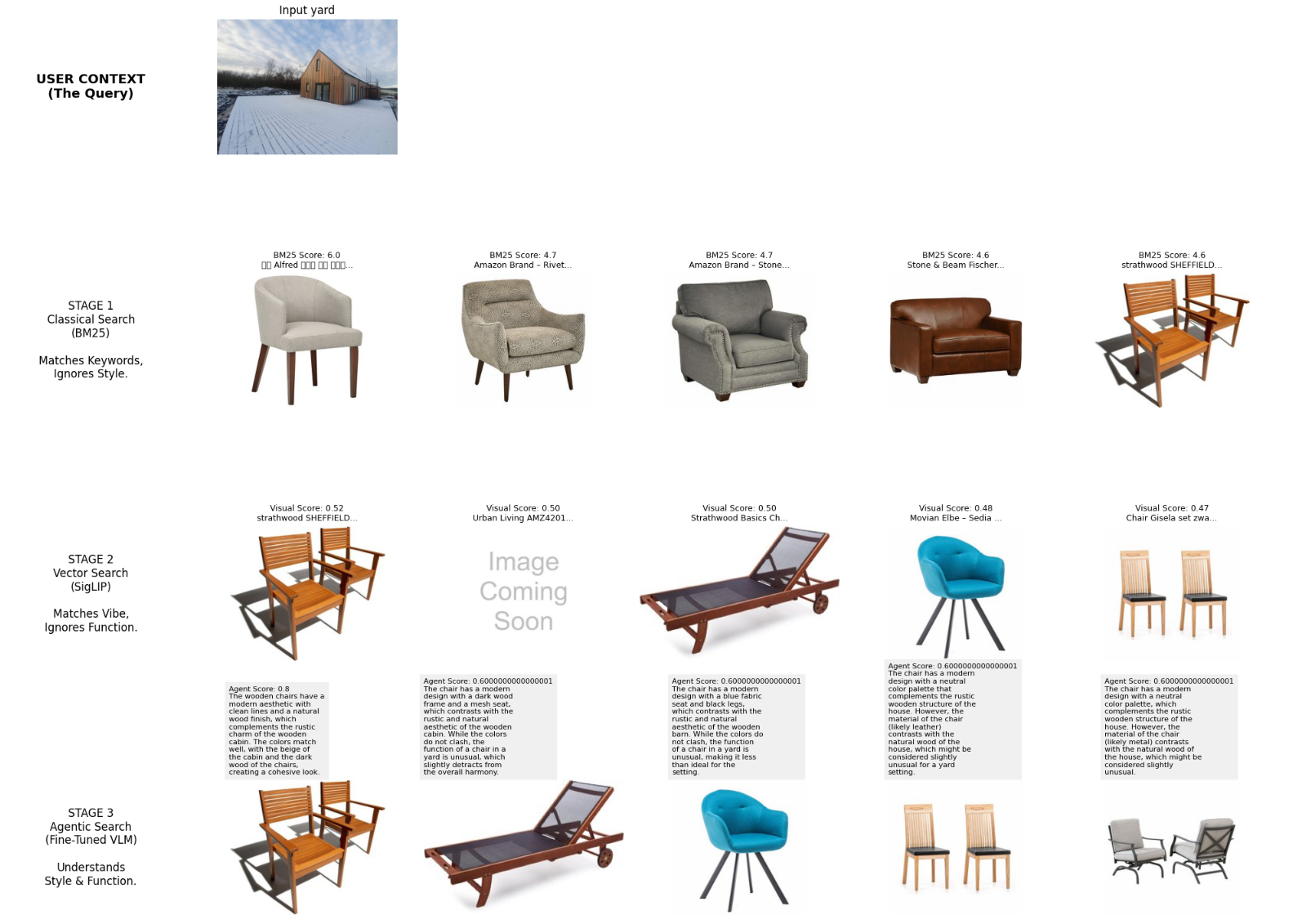
MARS (Multimodal Agentic Room Search) is an Agentic RAG pipeline designed to solve the “Visual-Semantic Gap” in e-commerce search. Unlike standard vector search engines that rely solely on pixel similarity, MARS employs a fine-tuned Vision-Language Model (VLM) to reason about stylistic coherence and functional constraints.
This project demonstrates an end-to-end GenAI Engineering workflow: from generating a proprietary synthetic dataset using Teacher-Student distillation to fine-tuning a lightweight agent using QLoRA and optimizing inference latency by 85%.
Project details
Features
- Agentic Architecture: Built a 3-stage funnel combining BM25, SigLIP, and a Fine-Tuned VLM, successfully differentiating between “Visual Matches” (textures/colors) and “Functional Matches” (context).
- Synthetic Data Engineering: Created a proprietary dataset of 1,500 visual critiques by deploying Qwen2.5-VL-7B as a “Teacher” to label hard-negative pairs mined from the Amazon Berkeley Objects dataset.
- Resource-Efficient SFT: Fine-tuned a Qwen2-VL-2B model on a single Nvidia P100 GPU using QLoRA (4-bit quantization), achieving SOTA-level reasoning capabilities with minimal compute.
- Production Optimization: Implemented Batched Inference for the agentic re-ranker, reducing query latency from 3 minutes to ~25 seconds.
Methodology
1. The Problem: The Semantic & Visual Gap
Standard search fails at complex intent. If a user uploads a photo of a swimming pool and searches for “Bed,” Vector Search (CLIP/SigLIP) returns a blue bed because it matches the color of the water. It fails to understand that beds do not belong in pools. MARS solves this by introducing a “Reasoning” stage.
2. The 3-Stage Funnel
- Stage 1: The Filter (Classical IR):
Uses BM25 to enforce semantic locking. If the user asks for a “Chair,” this stage guarantees we retrieve furniture tagged as chairs, filtering out visually similar but wrong categories (e.g., tables). - Stage 2: The Vibe Check (Vector Search):
Uses SigLIP-so400m embeddings to re-rank the text candidates based on visual similarity to the user’s room image. This filters out items that clash with the room’s color palette or texture. - Stage 3: The Agent (Reasoning):
The top candidates are passed to our Fine-Tuned Qwen2-VL Agent. The agent looks at the room and the product side-by-side and outputs a compatibility score (0-1) and a natural language rationale (e.g., “Low Score: This is indoor furniture in an outdoor setting.”).
3. Data Generation Strategy (Teacher-Student)
Since no dataset exists for “Interior Design Reasoning,” I engineered one:
- Mining: Used SigLIP to find “Hard Negatives” (items that look right but are wrong categories).
- Distillation: Prompted Qwen2.5-VL-7B (The Teacher) to critique these pairs, generating a score and a reasoning trace.
- Training: Fine-tuned the smaller Qwen2-VL-2B (The Student) to mimic this reasoning logic.
Insights & Conclusion
- Vectors imply Vibe, Agents imply Logic: Embedding models are excellent for surface-level matching (color/texture) but lack world knowledge. Integrating a small VLM agent adds the necessary “Common Sense” layer to search.
- Synthetic Data is King: A small 2B parameter model, when fine-tuned on high-quality, task-specific synthetic data, can outperform larger generalized models in specific reasoning tasks.
- Hybrid Retrieval is Mandatory: Relying purely on Vector Search often leads to semantic drift. Anchoring the search with Classical Retrieval (BM25) provided the necessary stability for the agent to work effectively.
Links
- Github: https://github.com/Loki-Silvres/MARS
- Demo Notebook: Kaggle - Hybrid IR Engine
- Amazon Berkeley Objects (ABO): ABO Dataset link
- House Rooms Dataset: Rooms Dataset link
- Synthetic Dataset: My Dataset link